Contents
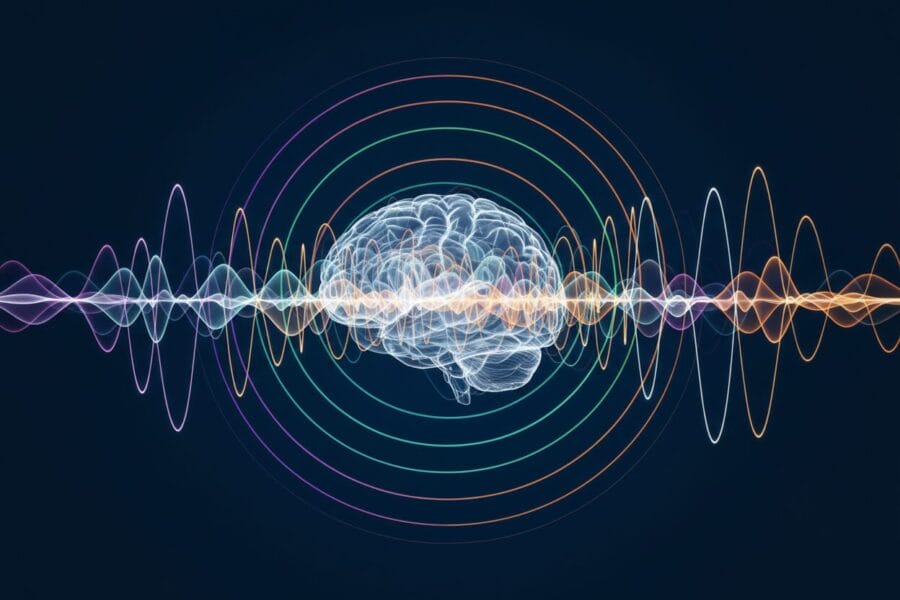
Your brain never goes quiet. Even during deep sleep, millions of neurons fire in coordinated rhythms, producing electrical signals that scientists can measure, map, and interpret. These rhythms are your brain wave patterns, and understanding them reveals a surprising amount about your mental state, cognitive performance, and overall neurological health.
As Harvard Medical School notes, “different states of mind are defined by distinct, characteristic waveforms, recognizable frequencies and rhythms in the electrical field of the brain.” That’s the scientific foundation behind neurofeedback, sleep research, and clinical EEG diagnostics.
The Five Core Brain Wave Types
Brainwaves are measured in hertz (Hz), representing cycles per second. Each frequency band corresponds to a distinct mental state, though multiple wave types are always active at once. Your brain is never running on a single channel.
Delta (0.5–4 Hz): The slowest waves, dominant during deep, dreamless sleep. Delta activity supports physical restoration and unconscious bodily regulation, and disrupted delta patterns are linked to sleep disorders and certain neurological conditions.
Theta (4–8 Hz): Associated with light sleep, deep relaxation, and the hazy state between waking and drifting off. Theta also surges during creative insight and memory consolidation, which is why solutions sometimes surface right before you fall asleep.
Alpha (8–12 Hz): The brain’s idle rhythm during relaxed wakefulness. Close your eyes and do nothing, and alpha waves spike. They act as a bridge between active thinking and subconscious processing, making them central to mindfulness and stress reduction.
Beta (12–30 Hz): Your default waking state. Low beta supports calm focus, while high beta correlates with active problem-solving, stress, and anxiety. This wide sub-band range is why understanding brainwave frequencies in depth matters more than simply labeling beta as “alert.”
Gamma (30–100 Hz): The fastest measurable band, tied to peak cognition, cross-regional information binding, and heightened sensory perception. Experienced meditators show unusually high gamma activity, a finding that continues to draw serious neuroscience attention.
Frequency and Amplitude: Two Dimensions, Not One
Most explanations stop at frequency, but that’s only half the picture. Brainwaves are also characterized by amplitude, the height of the wave, which reflects how many neurons are firing in synchrony. High amplitude signals large, coordinated activity; low amplitude suggests more localized or desynchronized firing.
A clinical EEG captures both dimensions simultaneously. This is why two people can show identical dominant frequencies but very different brain states. Individual neurological variability is real, and it means the same meditation session can produce strong alpha in one person and almost no measurable change in another.
How Brainwaves Are Measured
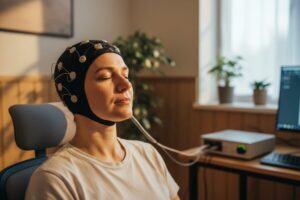
The Netherlands Institute for Neuroscience describes brainwaves as “small electrical currents that can be measured by the number of vibrations or waves per second.” The tool for this is the electroencephalogram, or EEG, which uses electrodes placed on the scalp to detect voltage fluctuations from neuronal activity.
Clinical EEGs use 19 to 256 electrodes and produce quantitative brain maps, known as QEEGs, that show which frequencies dominate in which regions. Consumer EEG headsets use far fewer electrodes and offer a simplified real-time snapshot. Both have legitimate uses; they just answer different questions. For a practical look at how to read a brain map and what different regions reveal, QEEG data is where the real diagnostic detail lives.
When Brainwave Patterns Go Wrong
Dysregulated brainwave patterns have clear clinical implications. Excess high-beta activity is consistently linked to anxiety and ADHD, while abnormal delta intrusion during waking hours can signal traumatic brain injury or cognitive impairment. Epilepsy is fundamentally a disorder of abnormal synchronized electrical activity, visible directly on EEG.
Neurofeedback therapy targets these dysregulations by training individuals to consciously shift their dominant wave states through real-time feedback. It has demonstrated efficacy for ADHD, PTSD, and certain sleep disorders in peer-reviewed research. Practices like mindfulness, aerobic exercise, and strategic sleep hygiene also produce measurable shifts in brainwave activity, with alpha and theta showing the most consistent changes.
The five types of brainwaves and their relationship to mental states form the foundation, but the real insight comes from understanding how these waves overlap, interact, and vary by individual. Your brain isn’t cycling through frequencies like radio stations; it’s running a full orchestra, all at once.