Contents
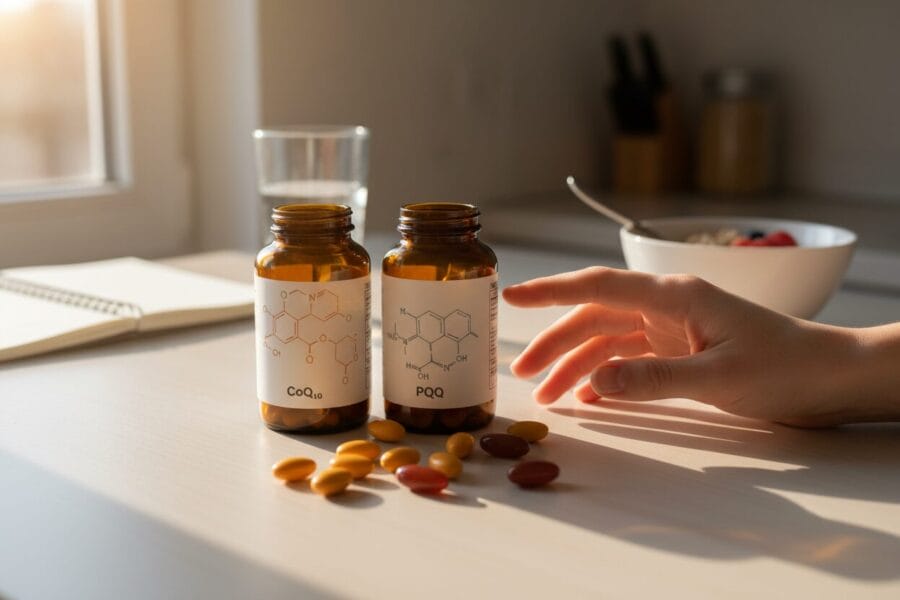
Two supplements keep coming up in conversations about cellular energy and longevity: CoQ10 and PQQ. Both support mitochondrial health, both have real research behind them, and both are frequently sold together. But they work through completely different mechanisms, and understanding that distinction matters before you spend money on either.
How Each One Works
CoQ10 (Coenzyme Q10) is a fat-soluble compound your body produces naturally. It sits inside the electron transport chain, shuttling electrons between protein complexes to drive ATP synthesis. Think of it as the spark plug inside each mitochondrion. Without adequate CoQ10, your existing mitochondria run inefficiently, which can show up as fatigue, brain fog, and poor recovery.
PQQ (Pyrroloquinoline Quinone) takes a different approach entirely. Rather than optimizing existing mitochondria, PQQ activates PGC-1α, a master regulator that triggers mitochondrial biogenesis, meaning the creation of entirely new mitochondria. As the sports nutrition team at bfesse.com puts it: “CoQ10 improves ATP output per mitochondrion, while PQQ helps the body produce more mitochondria, together they enhance both capacity and efficiency of cellular energy.”
Antioxidant Capacity: Not Even Close
Both compounds neutralize free radicals, but PQQ’s antioxidant stability is extraordinary. PQQ can perform over 20,000 catalytic conversions without degrading, compared to vitamin C, which performs only four. CoQ10, meanwhile, specifically protects lipid membranes and mitochondrial DNA from oxidative damage, a function PQQ doesn’t replicate. They’re complementary here, not interchangeable.
Brain Health and Cognitive Function
PQQ has a stronger nootropic profile overall. It stimulates Nerve Growth Factor (NGF), supports memory consolidation, and offers neuroprotection against oxidative stress. CoQ10’s cognitive benefits are more indirect, primarily through preventing the mitochondrial dysfunction that underlies age-related cognitive decline.
For people dealing with fatigue-related cognitive symptoms, the combination may be especially relevant. RTHM, a healthcare platform specializing in complex chronic illness, notes that sustained-release CoQ10 with PQQ may help manage fatigue, brain fog, and autonomic challenges in long COVID patients, though medical supervision is strongly advised.

Heart Health: CoQ10’s Home Turf
Cardiovascular support is where CoQ10 has the most established clinical evidence. The Q-SYMBIO and CORONA trials both examined CoQ10 supplementation in heart failure patients, with Q-SYMBIO showing significant reductions in major cardiovascular events. CoQ10 is also critical for anyone on statin medications, which are known to deplete the body’s natural CoQ10 levels.
PQQ contributes to heart health through anti-inflammatory pathways, including measurable effects on NFκB gene expression. A 2023 peer-reviewed study by Nalbant found that combined PQQ and CoQ10 application caused greater NFκB expression increases than either compound alone, suggesting real synergistic activity at the molecular level.
The Case for Taking Both
The synergy argument is more than marketing. PQQ builds new mitochondria; CoQ10 makes those mitochondria perform optimally. One without the other leaves real efficiency gains on the table.
A 2025 study published in Biology of Reproduction (Castillo-Castrejon et al.) adds another dimension: preclinical evidence suggests CoQ10 and PQQ may mitigate obesity-related fertility complications, including impacts on oocyte quality and pregnancy outcomes. This is an emerging area, but it signals that the combination has applications well beyond energy optimization.
For general use, here are the typical starting points:
CoQ10 Dosing: 100 to 300 mg daily; ubiquinol form is preferred for bioavailability, especially in adults over 40.
PQQ Dosing: 10 to 20 mg daily for standard mitochondrial and cognitive support.
Higher Doses: Those with specific cardiovascular or fertility goals may benefit from higher CoQ10 doses under medical guidance.
Who Should Be Cautious
Neither supplement is entirely without risk for certain populations. A few things worth knowing before you start:
- CoQ10 can interact with blood thinners like warfarin and may reduce their effectiveness
- People on chemotherapy should consult an oncologist before supplementing with either compound
- PQQ has a strong safety profile at research doses, but long-term high-dose data remains limited
- Neither supplement replaces medical treatment for any diagnosed condition
If you’re trying to figure out which products actually deliver on these mechanisms, our full CoQ10 and PQQ supplement breakdown covers top-rated options with dosing transparency and third-party testing data.
Bottom Line
CoQ10 and PQQ aren’t competitors. They target different parts of the same system: CoQ10 optimizes mitochondrial output while PQQ expands mitochondrial capacity. For most people focused on sustained energy, cognitive sharpness, or healthy aging, combining them at evidence-backed doses makes far more practical sense than choosing one over the other.